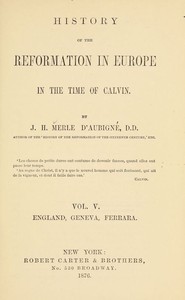
History of the Reformation in Europe in the Time of Calvin, Vol. 5 (of 8)
Welcome back to the 16th century, where religious revolution is the order of the day. Merle d'Aubigné's fifth volume picks up the story of the Protestant Reformation, but this time, the spotlight is firmly on Geneva and the formidable mind of John Calvin.
The Story
This isn't a biography of Calvin, but the story of his project. The book shows us Geneva transforming from a city that just kicked out its Catholic bishop into a laboratory for a new kind of society. We see Calvin arriving, getting kicked out himself after a couple of years by political opponents, and then being begged to return when things fall apart. The core of the narrative is his struggle to establish a church-led government. It's a battle on all fronts: against old Genevan families who loved their festivals and didn't want strict moral rules, against refugees flooding in who needed help, and against powerful neighbors like France and Savoy who saw this Protestant experiment as a threat. The plot is driven by constant tension—will the city hold together, or will the whole Reformation dream in Geneva shatter?
Why You Should Read It
What grabbed me was how human it all feels. D'Aubigné, writing in the 1800s, has a clear point of view (he's a fan of the Reformation), but he doesn't hide the messiness. Calvin comes across as brilliant, stubborn, and often in poor health, arguing until he's hoarse. You see the real cost of building something new: the political betrayals, the fear, the logistical nightmares of housing thousands of exiles. It makes you think about what it actually takes to turn an idea into a living, breathing community. It's less about abstract theology and more about the sheer, exhausting work of change.
Final Verdict
This is for the curious reader who finds the gaps in history more interesting than the headlines. It's perfect if you enjoyed the broad strokes of a series like The Story of Civilization and want to dive deep into one critical chapter. You don't need to be a scholar; d'Aubigné writes with a storyteller's flair. Be ready for a deep dive—it's one volume in a larger series—but think of it as a season in a great TV drama, focused on one pivotal location. If you've ever wondered how ideas shape cities and change lives, this book offers a fascinating, gritty, and surprisingly relatable answer.
Legal analysis indicates this work is in the public domain. Feel free to use it for personal or commercial purposes.