
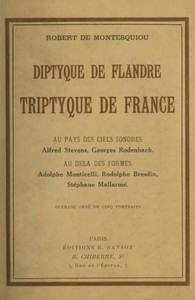
Diptyque de Flandre, triptyque de France by comte de Robert Montesquiou-Fézensac
Let's be clear from the start: if you're looking for a novel with a clear beginning, middle, and end, keep looking. Diptyque de Flandre, triptyque de France is something else entirely. It's a swirling collection of essays, observations, and critiques from Count Robert de Montesquiou, a man who treated his own life as his greatest work of art.
The Story
The 'story' here is the journey through Montesquiou's mind. The title refers to diptychs and triptychs—those multi-paneled paintings—and he uses that idea to structure his thoughts. He juxtaposes the art and culture of Flanders (modern-day Belgium and parts of France) with that of France itself. One minute he's dissecting a Rubens painting with razor-sharp precision, the next he's mourning the lost elegance of a forgotten social ritual or eviscerating the bad taste of a contemporary. There's no linear narrative, just a series of brilliant, often arrogant, tableaux painted with words. It's less about what happens and more about how one extraordinary man saw his world crumbling and decided to document every beautiful fragment.
Why You Should Read It
You read this for the voice. Montesquiou is hilarious, maddening, and fascinating. His snobbery is so extreme it circles back to being entertaining. He writes about beauty with a passion that's genuinely moving, even when you disagree with him. Reading this book is like discovering a secret door into the aesthetic battles of the Belle Époque. You get a front-row seat to what mattered most to the people who shaped modern art and literature—Proust, Whistler, and Wilde were all in his orbit. It’s not always comfortable, but it’s never boring. You’ll find yourself underlining sentences that are breathtakingly insightful about art, followed immediately by passages so petty you’ll laugh out loud.
Final Verdict
This book is a niche treasure. It’s perfect for history buffs and art lovers who want to go beyond textbooks and feel the pulse of a bygone era. If you enjoyed the social intricacies of Remembrance of Things Past or the witty decadence of Oscar Wilde, you’ll find Montesquiou a compelling, if difficult, companion. It’s also for readers who appreciate a strong, unique authorial voice, even when that voice is condescending. Fair warning: it’s not a light or easy read. But if you’re in the mood to be challenged and transported by a true eccentric, pick this up. You won’t read anything else like it this year.
Legal analysis indicates this work is in the public domain. It serves as a testament to our shared literary heritage.
Liam Davis
1 year agoEnjoyed every page.




Edward Rodriguez
7 months agoBeautifully written.