
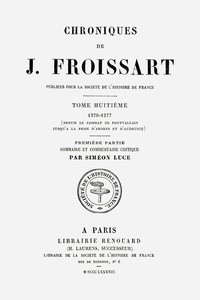
Chroniques de J. Froissart, tome 08.1/13 : 1370-1377 (Depuis le combat de…
Alright, let's set the scene. The year is 1370. The Hundred Years' War has been going on for decades, but the famous early English victories are a memory. King Edward III of England is aging, and his son, the Black Prince, is seriously ill. In France, King Charles V is on the throne. He's not a warrior king like his father; he's shrewd, calculating, and prefers to let his generals fight while he works the political angles. This volume covers the years where the war changes shape. Big, set-piece battles become rarer. Instead, it's a brutal war of raids, sieges, and economic strangulation.
The Story
Froissart doesn't give us a single, neat plot. He gives us a sprawling, messy reality. We jump from the English-held lands in France, where towns are rebelling, to the papal court in Avignon, tangled in its own politics. We see the rise of mercenary companies—bands of out-of-work soldiers who ravage the countryside, loyal only to pay. The story is really about power shifting. You watch the Black Prince, a legend in his own time, become too sick to lead, and his death creates a huge vacuum. In France, Charles V's strategy of avoiding big battles and letting his constable, Bertrand du Guesclin, wage a war of attrition starts to pay off. But it's not just about kings. Froissart spends just as much time on a knight's ransom negotiations or a city's struggle to stay neutral.
Why You Should Read It
This is where history gets personal. Froissart was a chronicler, but he was also a storyteller who talked to people. You get the exhaustion of the peasants, the boastful (and often exaggerated) tales of knights, and the cold calculations of kings. The theme that hits hardest is the sheer fragility of everything. A kingdom's fortune can reverse because of one bad winter, one illness, or one treacherous ally. It makes you realize how much of history hinges on human bodies breaking down and human loyalties being bought. It's not about grand national destinies; it's about individuals scrambling for survival and advantage in a world with no safety net.
Final Verdict
This isn't for someone who wants a quick, novelized version of history. It's for the reader who loves to get into the weeds. Perfect for history buffs who are tired of the textbook overview and want to feel the grit and chaos of the period. It's also great for anyone fascinated by the mechanics of power—how it's gained, kept, and lost. If you enjoy complex, character-driven narratives like Game of Thrones but want the real, unvarnished deal, Froissart is your original source. Be ready for a lot of names and places, but if you stick with it, you're getting a front-row seat to history as it was lived, not as it was later cleaned up.
This digital edition is based on a public domain text. Use this text in your own projects freely.
Susan King
2 months agoGreat reference material for my coursework.
Lisa Lopez
1 year agoBeautifully written.
Barbara Smith
1 year agoI had low expectations initially, however the character development leaves a lasting impact. Definitely a 5-star read.
James Moore
5 months agoThis is one of those stories where the storytelling feels authentic and emotionally grounded. Worth every second.





Dorothy Anderson
8 months agoNot bad at all.